Printable Piano Chord Chart for Beginners (Major and Minor)
We may earn a commission from links on this page, at no extra cost to you. Disclosure
Quick answer
A major piano chord is a root note plus the notes 4 and then 3 half steps above it (C major = C-E-G); a minor chord is a root plus 3 and then 4 half steps (C minor = C-Eb-G). Our free 2-page printable chart shows all 12 major and 12 minor triads, and the four chords C, G, Am and F (I–V–vi–IV) are enough to play hundreds of pop songs.
We may earn a commission from links on this page, at no extra cost to you. Disclosure
See the lessons & price →One-time $49 · 60-day money-back guarantee · Paid link
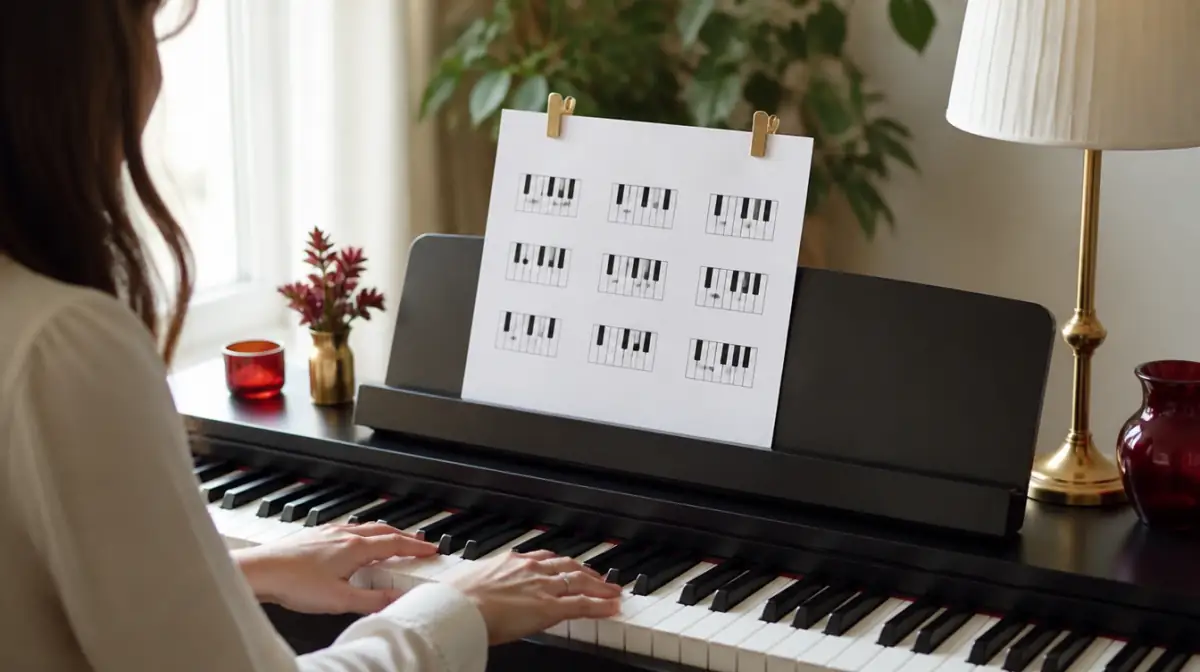
Quick answer: A piano chord chart shows which keys make each chord. Every major chord is a root plus the notes 4 and then 3 half steps above it, and every minor chord is a root plus 3 and then 4 half steps. Our free printable chart covers all 12 major and 12 minor triads on two pages, and the table below lists the exact notes for each one.
2 pages, US Letter: 12 major + 12 minor chords. Free, no email.
How to read the chord chart
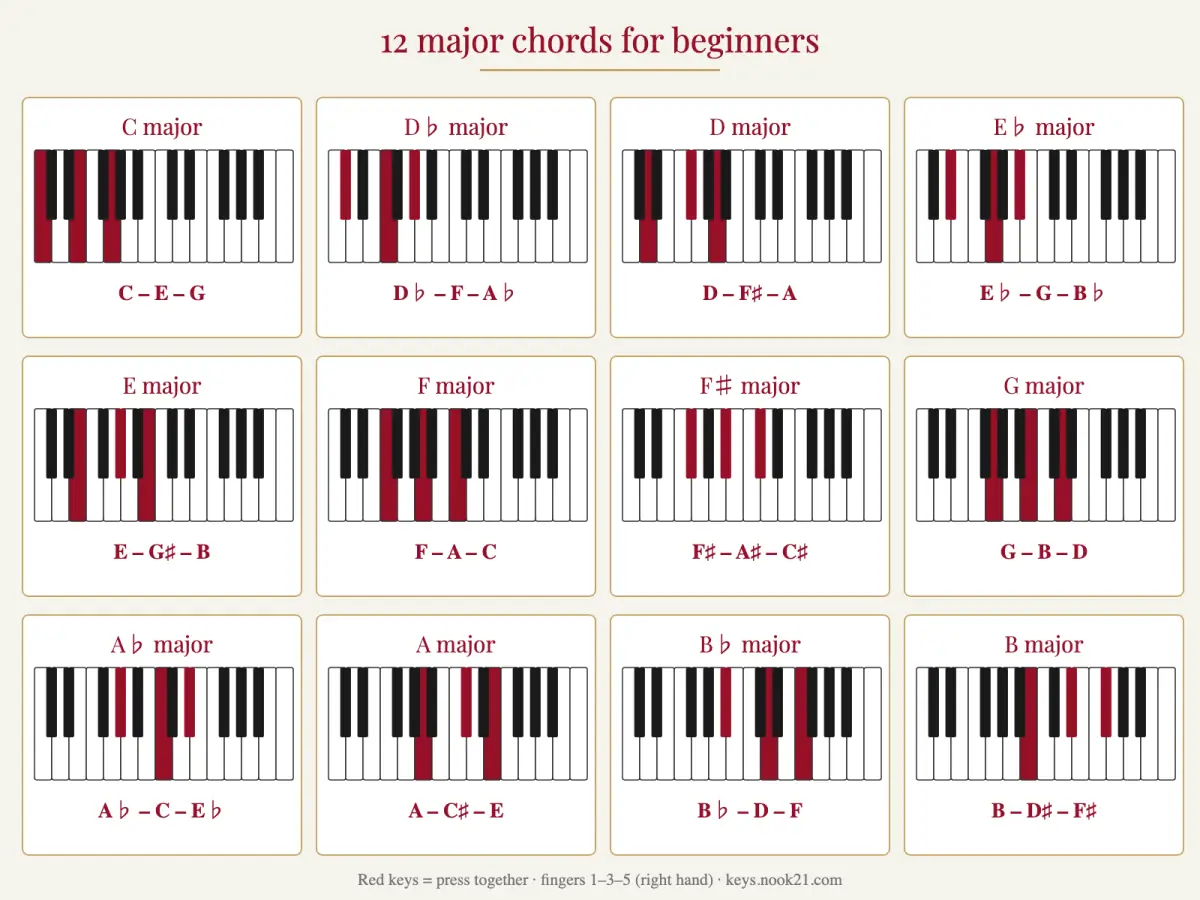
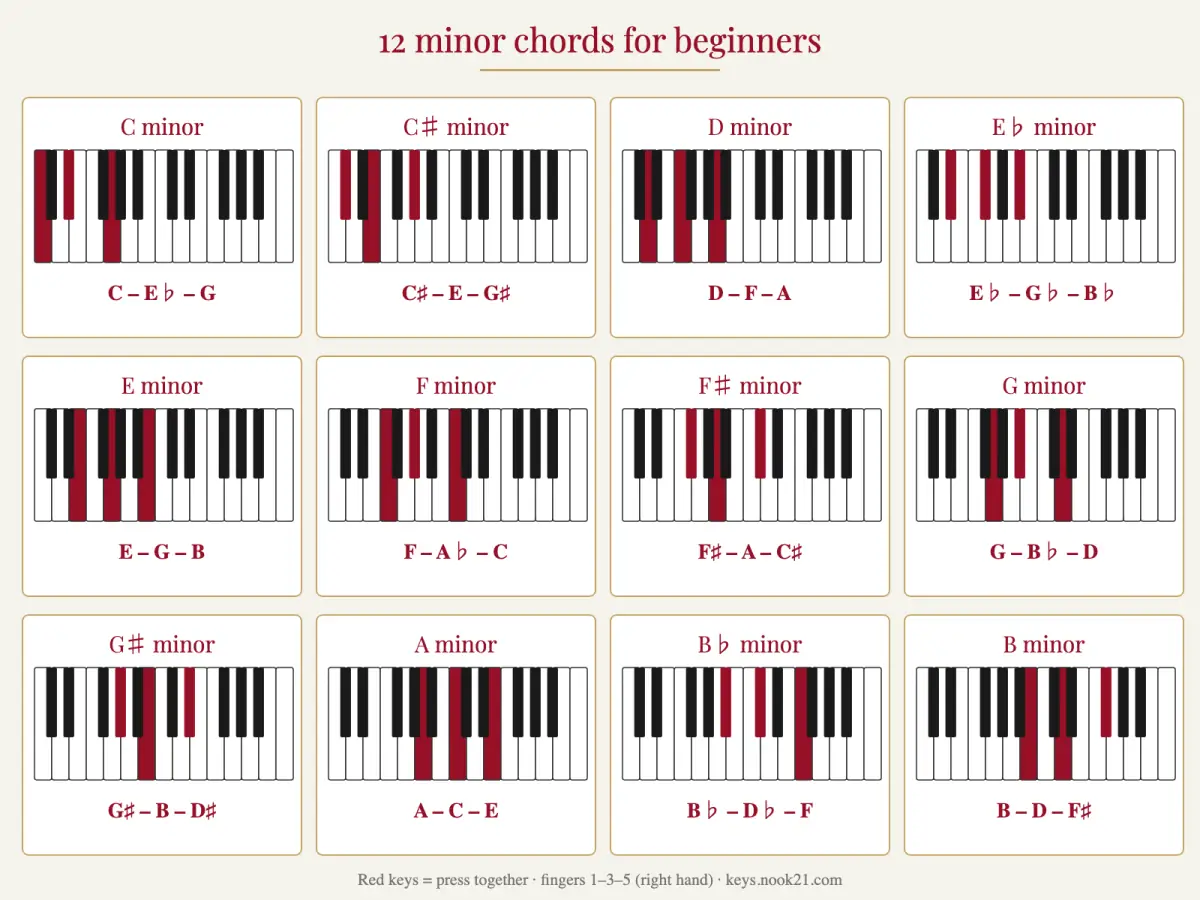
Each diagram shows one octave of keys, and the three red keys are the notes you press together. The chord name sits above the keyboard, and the note names sit under the red keys, lowest note first.
- Red keys: the three notes of the chord, played at the same time.
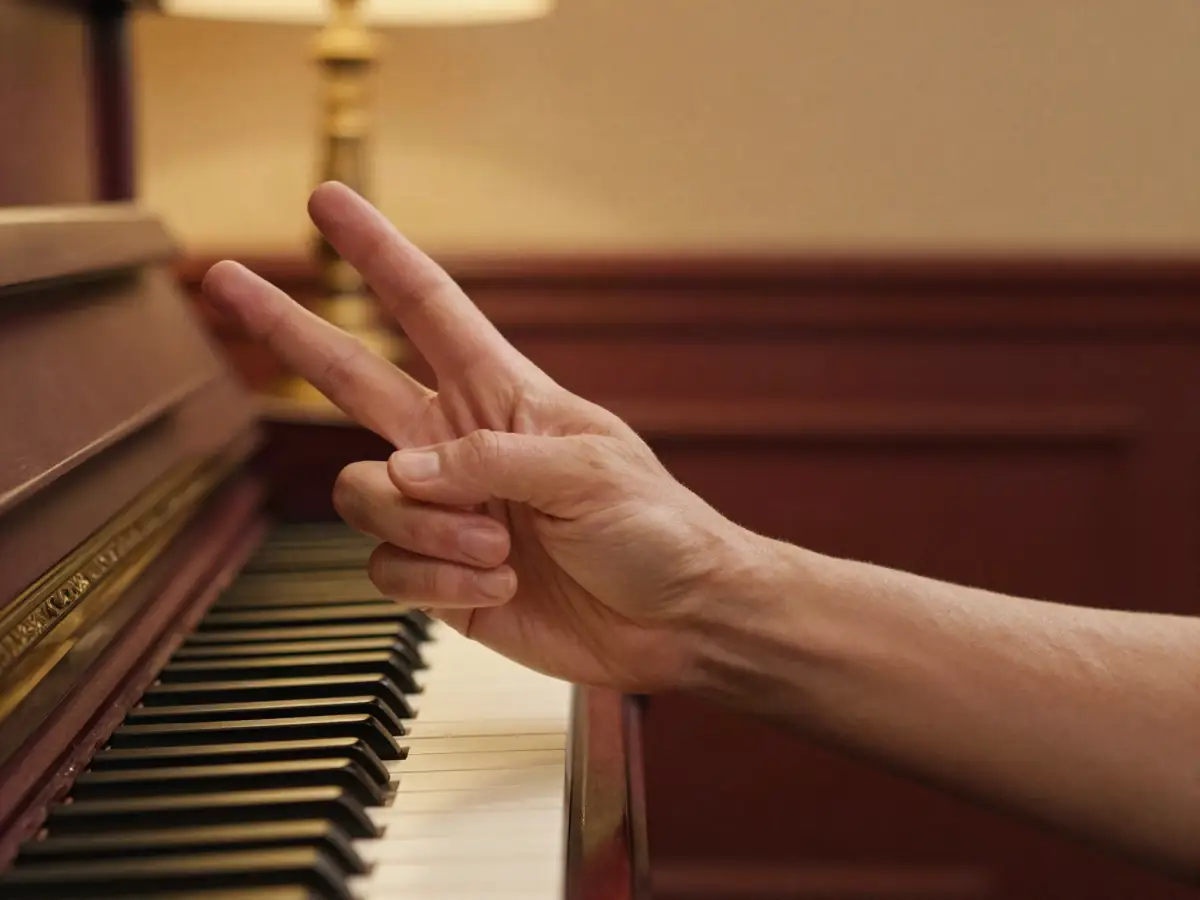
- Right-hand fingering 1-3-5: thumb (1) on the lowest note, middle finger (3) on the middle note, little finger (5) on the top note.
- Left-hand fingering 5-3-1: little finger on the lowest note, middle finger in the middle, thumb on top.
- Black keys: some chords use one or more black keys. The shape of your hand stays the same; your fingers just reach a little further in.
The formula behind every chord
A major chord is root + 4 half steps + 3 half steps; a minor chord is root + 3 half steps + 4 half steps. A half step is the distance from one key to the very next key, black or white.
Start on C and count up 4 keys: C#, D, D#, E. Then 3 more: F, F#, G. That gives C-E-G, the C major chord. For C minor, count 3 first (C#, D, Eb) and then 4 (E, F, F#, G): C-Eb-G. Only the middle note moves, one half step down.
That one-key difference is the whole sound change between "bright" major and "sad" minor. Once you can count it, you can build any chord without a chart.
All 12 major and 12 minor piano chords
This table lists the correct notes for every major and minor triad, from the root up. It matches the printable chart, so you can check a chord here when the PDF is not at hand.
| Major chord | Notes | Minor chord | Notes |
|---|---|---|---|
| C | C-E-G | Cm | C-Eb-G |
| Db | Db-F-Ab | C#m | C#-E-G# |
| D | D-F#-A | Dm | D-F-A |
| Eb | Eb-G-Bb | Ebm | Eb-Gb-Bb |
| E | E-G#-B | Em | E-G-B |
| F | F-A-C | Fm | F-Ab-C |
| F# | F#-A#-C# | F#m | F#-A-C# |
| G | G-B-D | Gm | G-Bb-D |
| Ab | Ab-C-Eb | G#m | G#-B-D# |
| A | A-C#-E | Am | A-C-E |
| Bb | Bb-D-F | Bbm | Bb-Db-F |
| B | B-D#-F# | Bm | B-D-F# |
Why Db major but C# minor? Both names point to the same black key. We use the spelling you will see most often in songbooks and chord charts, so the chart matches the music you actually read.
The 4 chords that play hundreds of songs
C, G, Am and F, played in that order, form the I–V–vi–IV progression found in a huge number of pop, rock and worship songs. If you learn only four chords from the chart this month, learn these.
| Step | Chord | Notes | Role in key of C |
|---|---|---|---|
| 1 | C | C-E-G | I (home) |
| 2 | G | G-B-D | V |
| 3 | Am | A-C-E | vi |
| 4 | F | F-A-C | IV |
Play each chord for four slow beats, then loop back to C. All four use only white keys, so you can focus on clean changes instead of reaching for black keys. Many songs start the same loop on a different chord, such as Am-F-C-G, which is the same four chords in a new order.
When the loop feels easy, try it in G major: G, D, Em and C. The roles stay the same, and the chart shows you each new shape.
Ready to turn these chords into songs? Pianoforall starts with chords and rhythm patterns before note reading ($49 one-time, 60-day refund window, checked October 13, 2026).
See how it teaches chords →Paid link · opens the vendor's sales page.
A 10-minute daily practice routine
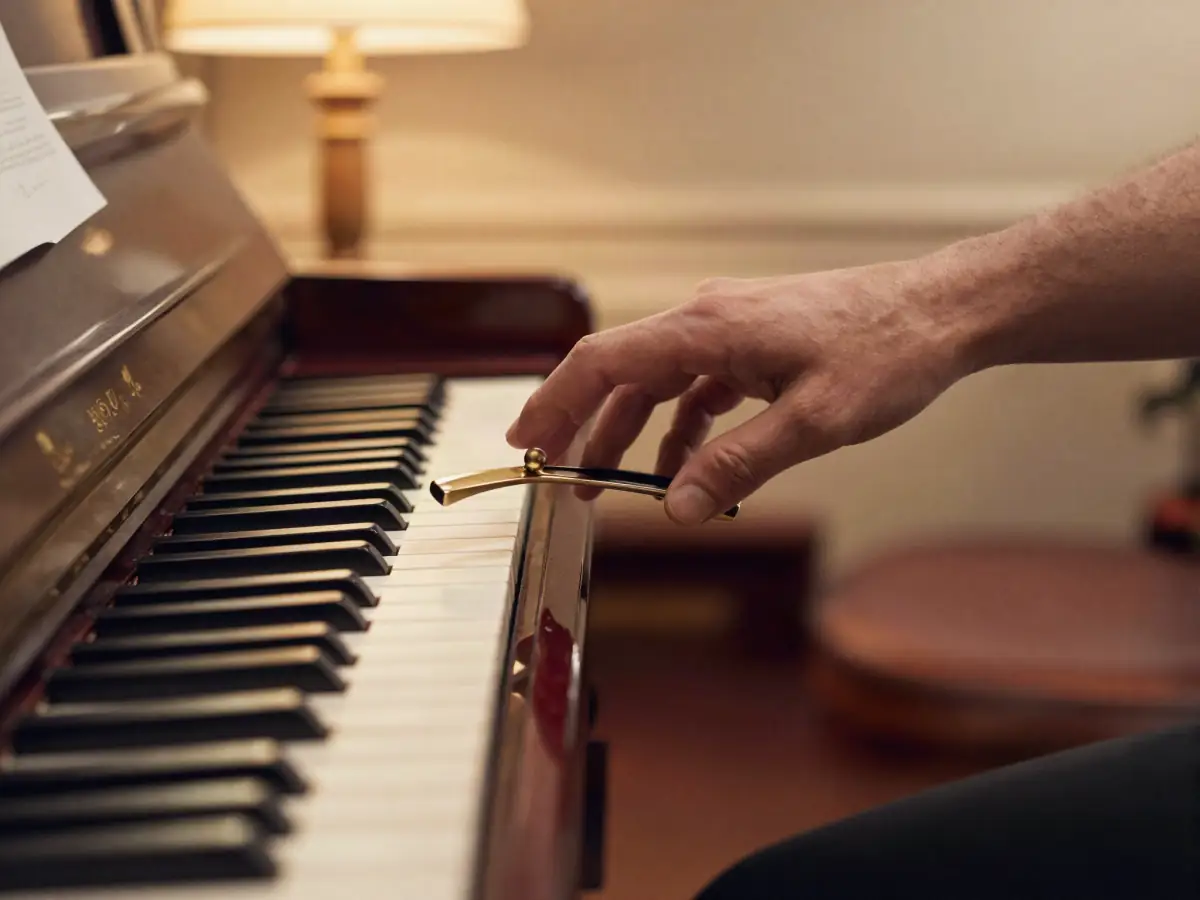
Ten focused minutes a day with the chart builds chord shapes faster than one long session a week. Keep the chart on the music stand and follow this order.
- Warm up (1 minute). Play C major with the right hand, lift, and play it again. Relax your wrist between each one.
- Two new chords (3 minutes). Pick two chords from the chart. Play each one 10 times, saying the note names out loud.
- Change drill (3 minutes). Switch between your two new chords on a slow count of four. Aim for no gap between them.
- Left hand (1 minute). Play the same chords with the left hand using 5-3-1, lower on the keyboard.
- Progression (2 minutes). Loop C-G-Am-F, adding one new chord where it fits.
Tick off chords on the printed chart as they become easy. If your hands or wrists hurt, stop and see a doctor rather than pushing through.

Next step: chord inversions
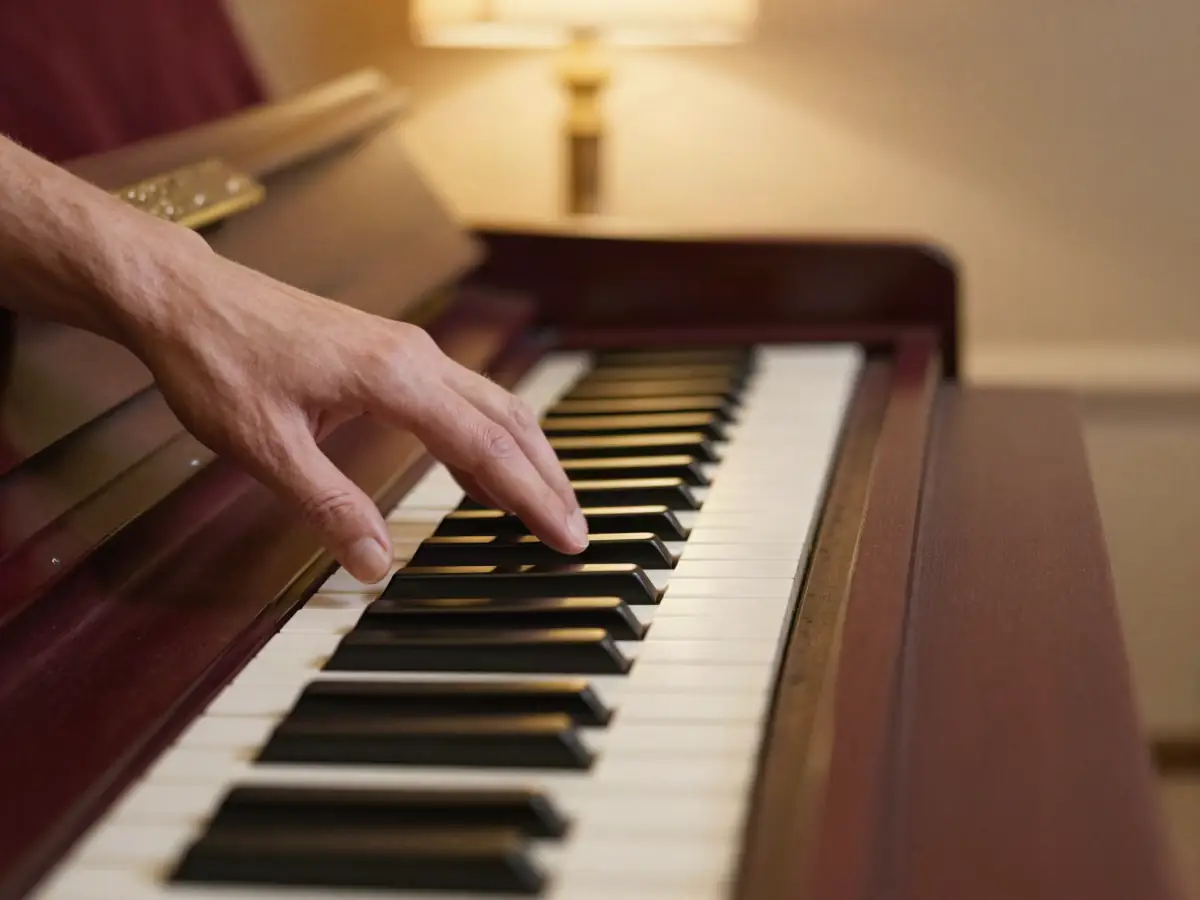
An inversion plays the same three notes of a chord in a different order, so your hand moves less between chords. C major can be C-E-G (root position), E-G-C (1st inversion) or G-C-E (2nd inversion).
Jumping from C to G to F in root position makes your hand leap around. Using inversions, you can play C (C-E-G), then G as B-D-G, then F as C-F-A, and your hand barely moves. That is how most pianists play chord progressions.
Our post on your first three piano chords walks through C, F and G with inversions, step by step.
Chord inversions have a full book of their own. Pianoforall covers inversions, ballad patterns and improvising, with about 300 video lessons according to the vendor.
See the lesson order →Paid link · opens the vendor's sales page.
Common mistakes with chord charts
Most early chord problems come from hand tension and rushing, not from the chart. Watch for these.
- Flat fingers. Keep your fingers curved, as if holding a small ball, so each key goes down cleanly.
- Uneven notes. All three notes should sound together. Press from the knuckles, not by dropping your wrist.
- Looking at the chart while changing. Glance at the next chord before the change, then watch your hand.
- Learning all 24 at once. Two new chords a day is plenty. The chart is a reference, not a test.
- Skipping the left hand. Practice each chord in both hands. Many songs put the chord in the left hand while the right plays the melody, so both need the shape.
Turn chords into songs
A chord chart tells you what to play; a course shows you how to make it sound like music. Rhythm patterns, left-hand bass lines and inversions are what turn four held chords into a song people recognize.
Pianoforall, created by Robin Hall and sold since 2006 according to the vendor, is built around this chords-first idea. It starts with party-style rhythm patterns, then moves through blues, inversions, ballads, improvising and jazz, and adds classical pieces and sight-reading later. It is 10 ebooks with embedded video and audio, $49 one-time with no subscription, and it comes with a 60-day money-back guarantee (checked October 13, 2026).
The honest limits: there is no teacher feedback or note detection, the video style looks dated, and some independent reviewers find its sight-reading coverage light. If you want reading-first lessons, see our guide on piano by ear vs reading music. For the full picture, read our Pianoforall review.
Money-Back
Try it with the chart beside you
Pianoforall is a one-time $49 payment. If it does not suit you, refunds are available for 60 days through the vendor or the retailer (checked October 13, 2026).
Keep the free chart, add the songs. One payment, no subscription, works offline on Windows, Mac, iOS and Android.
Check the current price →Paid link · opens the vendor's sales page.
Frequently asked questions
How many piano chords are there for beginners?
Start with the 24 basic triads: 12 major and 12 minor, one of each on every key. Most beginners only need 4 to 8 of them, such as C, G, Am and F, to play many popular songs.
What is the formula for a major and a minor chord on piano?
A major chord is the root plus the notes 4 and then 3 half steps above it. A minor chord is the root plus 3 and then 4 half steps. For example, C major is C-E-G and C minor is C-Eb-G.
Which fingers do I use to play a piano chord?
For a basic three-note chord, the right hand uses fingers 1-3-5 (thumb, middle, little finger) from the bottom up, and the left hand uses 5-3-1 (little finger, middle, thumb).
What are the 4 chords that play most pop songs?
In the key of C they are C, G, Am and F, the I–V–vi–IV progression. In the key of G the same pattern is G, D, Em and C.
Is the printable chord chart really free?
Yes. The PDF is 2 US Letter pages with all 12 major and 12 minor chords, and it downloads directly with no email sign-up.
What should I learn after the basic chord chart?
Learn chord inversions next, so your hand moves less between chords, then add simple left-hand bass notes and rhythm patterns. A chords-first course such as Pianoforall ($49 one-time, checked October 13, 2026) teaches these in order.